
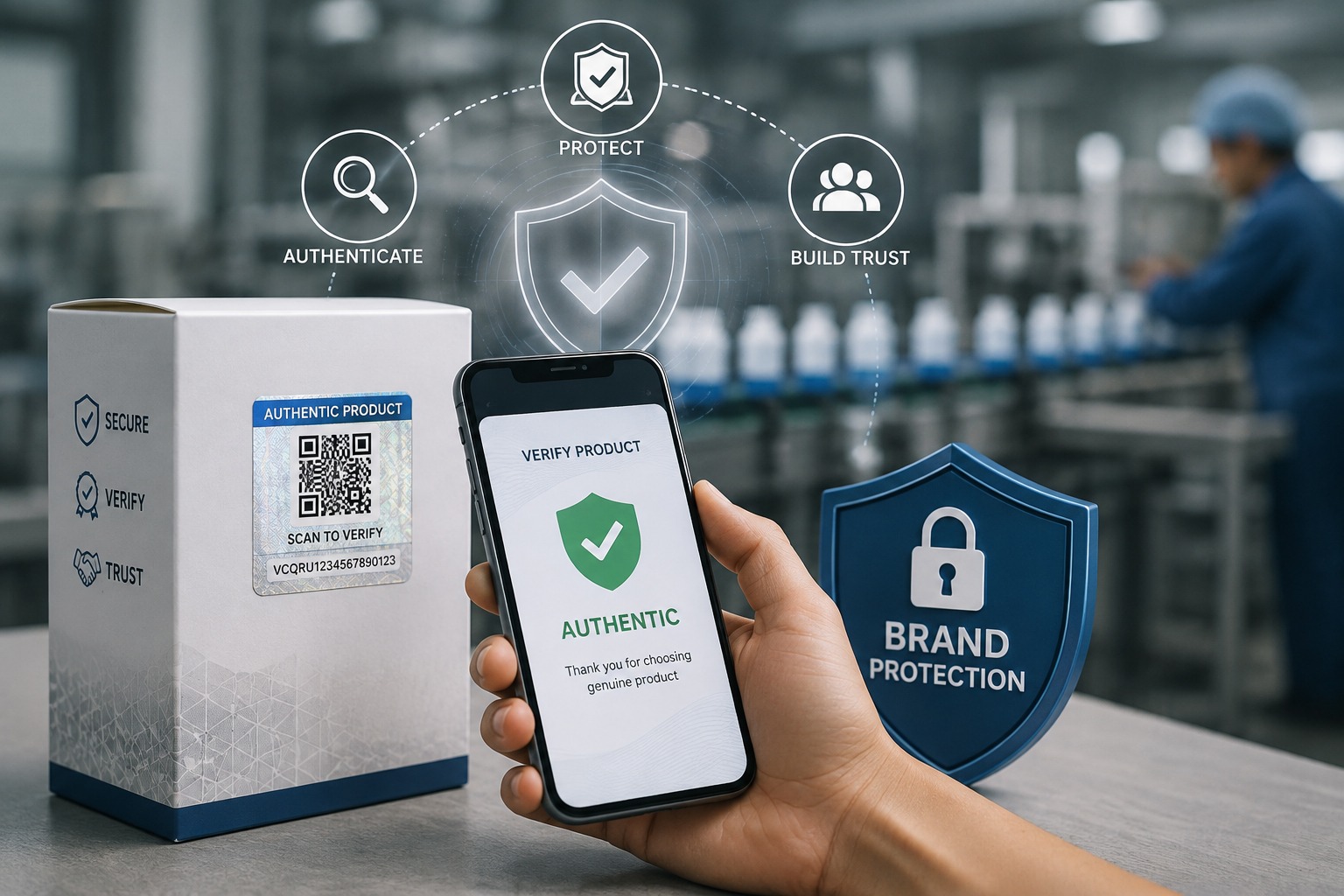
Products made in factories have become increasingly vulnerable to imitation. Be it drugs, FMCG products, auto parts, electronics, oils, beauty products, and consumables – counterfeit products can find their way into legitimate supply chains and reach consumers without manufacturers even being aware of it. Beyond monetary losses, counterfeiting products can have an adverse effect on brand image and safety.
Here is where product authentication solutions for manufacturers may come in handy. With the help of unique product identification, digital verification, serialization, smart tags, and supply chain transparency, manufacturers can build a better mechanism for authenticating products and spotting suspicious behavior.
What Are Product Authentication Solutions?
Product authentication technologies are a type of technology meant to assist manufacturers in confirming whether a product is real or fake. This type of technology gives each product or packaging unit a unique digital ID that can be verified by either the manufacturer or consumer.
Current day authentication solutions employ various technologies including encrypted QR codes, NFC, RFID, serialization, smart labels, and verification platform. Authentication can be incorporated into the manufacturing process based on the business requirements.
The aim is not just placing a QR code on the product packaging. An effective authentication solution links the product physically to reliable digital information.
Why Manufacturers Need Product Authentication
Fake producers have started being able to copy all the external features of products including packaging and labeling. Therefore, using a traditional printed identifier is not sufficient to protect products anymore.
There are several crucial reasons why authentication is necessary for manufacturers:
1. Reduce Counterfeit Product Risk
The individual identity of each item makes any unauthorized duplication unlikely. The fact that each product will possess some kind of digital credential is beneficial for setting up an additional verification process.
2. Protect Brand Reputation
Consumers want to get real products made by manufacturers. If counterfeit products come into circulation, they might negatively influence the customer experience and make people doubt about product quality. Authentication gives consumers an opportunity to verify products prior to purchasing.
3. Improve Supply Chain Visibility
In connection with the fact that authentication can work together with the track and trace system, there will be an increase in transparency in manufacturing, distribution, and retailing.
Read Also: Track & Trace in Supply Chain Management: Benefits for Manufacturers
4. Support Faster Detection
Multiple scanning, duplicate authentication requests, strange location and verification patterns can be signals of counterfeit product presence.
5. Strengthen Customer Engagement
Verification process itself can become a tool of communication between consumers and the company. Consumers will be able to receive product information, warranty information, product registration opportunities, loyalty program advantages or any other company services after verification.
Key Features of a Product Authentication System
The product authentication system should provide more advanced functionality than code generation alone. Manufacturers should seek solutions which integrate different protection and verification techniques.
Security and Unique Product Codes
Each product can be assigned a unique serial number. The manufacturer may choose among a variety of identification tools, such as QR codes, NFC tags, RFID technologies, or any other means.
The uniqueness will help to distinguish between the authentic product and a copy and is the first step towards product-level verification.
Product Verification
The buyer, the distributor, retailer, or any other field representative can check the code of the product he/she has received in order to prove the authenticity.
Read also: Case Study - How FMCG Brands Are Winning Against Counterfeiting
Serialization
Serialization assigns each product or packaging unit its own identity. As a result, the manufacturer gets better visibility compared to those systems which identify a product or product batch.
Serialization can be used also in the processes of product tracking, stock management, recalling process, or supply chain investigation.
Track & Trace
When authentication is integrated with tracking of the product through the supply chain, it becomes much more powerful. The manufacturer will know the entire movement of the product from the moment of production till delivery to the retail shelf.
The track and trace technology offered by VCQRU combines serialization, GPS tracking, blockchain authentication and logistics visibility. It can be applied in various industrial sectors like FMCG, pharmaceutical, automotive, electronics, consumer goods.
Smart and Secure Labels
Physical protection can complement authentication. Such smart labels, QR based labels, holograms, NFC/RFID tags, covert features, UV elements, security adhesives can help to protect the packaging against imitation.
Protection ecosystem described by VCQRU combines the secure code generation, smart label printing and integration with the production line.
Analytics and Monitoring
The process of authentication produces data. The manufacturer can analyze this data in order to evaluate the customer behavior, suspicious scan patterns, geographical activity, possible counterfeit hot spots.
In this way, authentication becomes the source of business intelligence.
How Product Authentication Works for Manufacturers
An example of the process of product authentication usually includes several phases.
Step 1: Product Registration
The manufacturer registers the product, SKU, batch or unit within the authentication system.
Step 2: Creation of a Secure Identity
A unique digital identity or secure authentication code is created for each relevant product.
Step 3: Code Application
The identity is connected with the product through a QR code, smart label, NFC tag, RFID tag, or any other technology similar to these.
Step 4: Product Distribution
Products travel through the existing channels of distribution of the manufacturer, and supply chain events are registered.
Step 5: Authentication
The consumer, distributor, retailer or representative of the company scans the product code.
Step 6: Verification and Notifications
The system verifies product data and gives a result of product authentication. Possible suspicious behavior is notified.
Step 7: Analysis
Manufacturers have access to information on authentication and can change their brand protection strategy.
Industries That Can Benefit
Product authentication is beneficial to various manufacturing industries.
Pharmaceuticals: It aids in product authentication and traceability, as well as supply chain management.
FMCG: It will protect those products that are purchased regularly and may be subject to duplication or counterfeiting.
Automotive: It will help authenticate the spare parts and components and ensure visibility of the product lifecycle.
Electronics: It will assist in ensuring that the products, accessories, and components are genuine.
Lubricants: It will help tackle issues such as the refilling and duplication of packaging.
Cosmetics: It offers another measure of protection against any counterfeited cosmetics.
Electrical products: Product authentication assists in distinguishing real electrical products from those that are counterfeit.
Benefits Beyond Counterfeit Prevention
One of the key benefits of modern authentication systems is that their utility goes way beyond preventing the occurrence of counterfeits.
Authentications systems allow manufacturers to gain visibility into their supply chains, manage recalls, monitor distributors, manage inventories, engage with customers and protect brands.
For instance, in case a particular batch of products has to be recalled, a digital product identity helps manufacturers identify such product instances much more efficiently. Likewise, unusual activity in authentications in a specific geographical location can provide valuable information about any counterfeit distribution operations.
Choosing the Right Product Authentication Solution
Before choosing an authentication partner, some important criteria need to be considered by the manufacturers.
There should be a technology which is able to work with the current manufacturing and packaging process and will not cause any additional complexity. There is also the aspect of scalability since the number of necessary checks and requirements may increase as production expands.
Manufacturers should take into consideration:
- Security and uniqueness of the product ID
- Authentication via QR, NFC, RFID, or another method
- Serialization capability
- Supply chain traceability
- Real-time monitoring and reporting
- Compatibility with current systems
- User-friendly authentication
- Data protection and management
- Industries' specific requirements
- Scalability for various products and sites
Good authentication system should work with the manufacturing process, not as a separate technology.
Building a More Trustworthy Product Ecosystem
However, counterfeiting protection is not just the detection of fakes that have found its way into the market. In many cases, it is crucial to implement a proactive strategy that includes product identity, authentication, traceability, monitoring, and consumer engagement.
In the age of product authentication solutions for manufacturers, companies have the ability to forge a digital relationship between the product and its confirmed identity. This will allow for systematic counterfeit detection and improve manufacturers' ability to control the supply chain and instill trust in consumers.
VCQRU offers technologies for counterfeiting protection and product authentication that can be used in different industries, such as FMCG, pharmaceuticals, automotive industry, lubricants, electrical products, and plywood.
Due to the increasing complexity of manufacturing and distribution networks, product authentication is becoming an integral element of brand protection strategy. Proper product authentication solutions can help to protect products, get more visibility, detect suspicious activity, and build trust among distributors, retailers, and end customers.

.jpg)
