
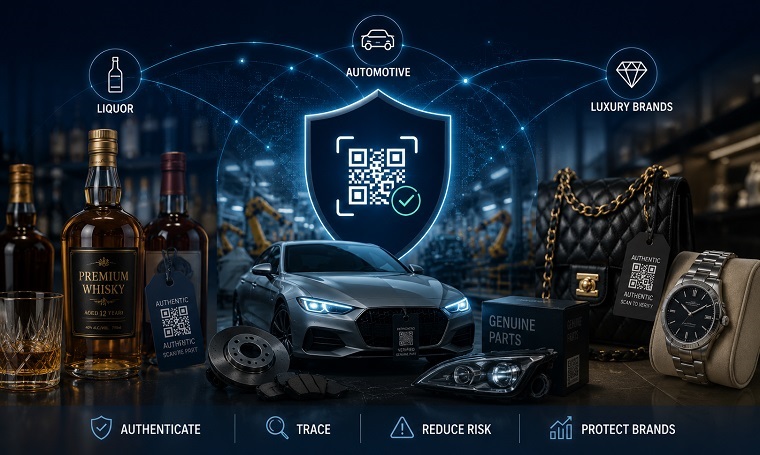
The practice of counterfeiting no longer remains an obscure one. In fact, it poses such severe risks as to cost the global economy around $1.8 trillion every single year. What do these statistics mean for companies in some of the hardest-hit sectors? Here's everything you need to know.
The cost to the world economy of counterfeits and piracy is $1.8 trillion per annum. These figures translate into severe implications for businesses through their impact on product safety, brand reputation, and lost revenues. Indeed, counterfeit practices affect industries such as liquor, automotive spare parts, and luxury items especially severely.
Getting to know how fakes infiltrate markets and the potential of modern technologies for product authentication is essential.
- 30% of luxury items purchased online are counterfeit products.
- 20% of auto spare parts available in the market are fake.
- An estimated $45 billion in losses annually from counterfeit auto parts.
- A 35% increase in counterfeit spare parts due to online platforms.
Why Are These Three Industries Targeted by Counterfeiters
Counterfeiters chase after lucrative products and industries. They prefer to sell products that have high demand in the market, well-known brands, and extensive distribution networks, which are prevalent in all of these industries.
The Liquor Industry
Alcoholic beverages are among the riskiest counterfeit products on the market today. Fake spirits sold under the guise of well-known whisky, wine, or craft beer companies may contain toxic or even lethal compounds. Not only does this pose risks to consumer safety, but counterfeit products also result in significant long-term damage to a company's reputation.
This is further complicated by the international nature of alcohol distribution, which involves multiple parties, such as importers, distributors, wholesalers, and retailers. In addition, traditional authentication methods, such as holograms and serial numbers, become less effective as counterfeiters adopt advanced methods.
The Automotive Aftermarket
According to reports, counterfeit spare part suppliers rob the Indian automobile industry of up to ₹22,000-₹30,000 crore annually. Among the most commonly counterfeited auto parts are brake pads, engine oils, filters, and suspension components. What makes matters worse is that purchasing a poor-quality brake pad and an unauthorised oil filter can have dire consequences. Some research indicates that 30% of road accidents in India are caused by substandard or counterfeit automotive components.
Due to the fast emergence of grey markets and online marketplaces, it has become easier than ever before for counterfeit auto parts to reach consumers without being detected.
Counterfeit Luxury Items
The luxury segment has always been one of the main targets of counterfeiters. It ranges from fake watches to counterfeited handbags and cosmetic products. According to estimates, approximately 30% of luxury items purchased online are fake or counterfeit. Apart from lost revenue, counterfeiting affects brands' equity and reputation, deceives consumers and diminishes their exclusivity.
Key Insight: All in all, in all of the mentioned industries, traditional methods of preventing counterfeits, such as holograms, barcodes and even RFID, are becoming less effective due to modern counterfeiters' capabilities for replication.
Anti-Counterfeiting Strategies of Today
The good thing is that technology has progressed a lot further than old-school security labels. Companies interested in protecting the integrity of their products are implementing highly sophisticated systems that are almost impossible to duplicate but simple to authenticate for consumers.
Optical Authentication Labels – Multi-Layer
Modern optical security labels have come a long way from their predecessors. Optical microstructure-based security labels utilise multi-layered refractive nano-structure moulding, which enables consumers to verify authenticity instantly without any special hardware. The reason why these structures are difficult to reproduce is that they require patented semiconductor manufacturing techniques, which cannot be replicated using today’s modern printing methods.
Benefits of optical authentication labels:
- Naked-eye authentication, no apps needed.
- Structures that are resistant to copying.
- Suitable for most types of packaging.
- Optional use of QR code/NFC for an additional digital level of security.
Intelligent QR Codes and Digital Verification Platforms
Just one encoded QR code, connected through a robust and secure backend platform, enables unique identification for each unit of an item produced. The consumer, dealer, and distributor can use a smartphone application, WhatsApp, SMS message, or even a website to scan the QR code within seconds and receive immediate "Genuine" or "Counterfeit Warning" notification. Such instantaneous identification proves especially helpful in the automotive aftermarket, where the quality of installed parts is key.
Tracking and Tracing in the Supply Chain
Complete transparency in terms of tracking a product within the entire supply chain makes it possible for a brand to monitor its products from manufacturing until they reach the end-user customer. With geo-location capabilities, counterfeit hotspots for specific areas, and duplicate scanning capabilities, brand owners have access to real intelligence about how to enforce against counterfeits.
Blockchain-Enabled Transaction History
For expensive alcoholic beverages or luxury goods, blockchain technology provides a permanent ledger documenting each transaction along the supply chain of the product in question. Through a simple QR scan upon purchase, the buyer is able to determine that the bottle is indeed authentic.
What Brands Can Do Today to Reduce Their Risk?
It is important to understand that reducing the threat of counterfeiting is not a one-time endeavour but something that needs to be taken into account regularly. The following actions need to be considered by brands operating in these industries:
- Analyse your supply chain to determine where counterfeit goods will most likely infiltrate your distribution channels.
- Introduce Enhanced Labelling – Go beyond the usual hologram protection and opt for unique optical structures.
- Allow Customers to Authenticate Their Purchases – Provide consumers with a quick and reliable tool for identifying genuine products.
- Use Real-Time Analytics Tools – Introduce dashboards that will highlight any suspicious activities, such as duplicate scans or verifications performed in unusual geographic locations.
- Educate Your Partners – Mechanics, dealers, and distributors may become your best allies in identifying counterfeit products.
- Proceed with legal actions based on intelligence gained through detection.
Conclusion
The reality is that counterfeiting will not go away on its own. This is true for liquor companies trying to protect their consumers, automotive companies trying to protect drivers, and luxury goods companies with years of established reputation to safeguard. The fact of the matter is that for the best brands of today, a combination of all of these things into one cohesive solution is critical to future success.

.jpg)
