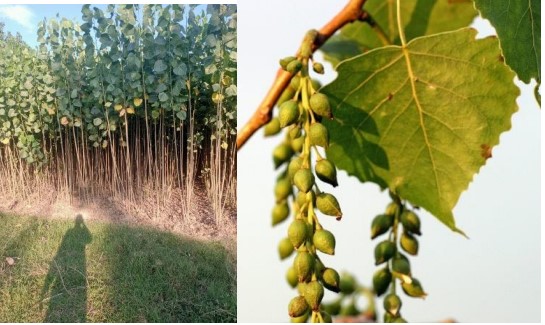
❖ Common name- Eastern Cottonwood
❖ Scientific name- Poplar deltoides
❖Classification-Kingdom- Plantae
Family- Salicaceae
Order- Malpighiales
❖ Mode of propagation-
Poplar is propagated through seeds, cuttings, and tissue culture. The most deployed conventional
propagation technology is stem cutting. By Seed: Seeds are occasionally used to make seedlings under
research programs. By Vegetative During the dormant season (January to February), cutting of 20 to 22
cm in length and 1 to 2 cm in diameter are taken from branches and epicormic shoots. Treat the cuttings
with Aldrin by thoroughly mixing 250 ml Aldrex 30 E.C. in 100 liters of water and Emisan-an organo
mercurial fungicide (250 gm Emisan-6 in 100-litre water) for 10 minutes. Cutting should be planted at
80 cm x 60 cm in the inverted position. Irrigation should be provided as soon as the planting of cuttings
is completed.
❖ Uses-
The wood of eastern cottonwood is typical of the Populus family in its softness, weighing just 0.45
g/cm3 (28 pounds per cubic foot). It is utilized for things like plywood and interior parts of furniture. It
is used especially in treating rheumatism and fevers, and to relieve the pain of menstrual cramps. An
infusion of the bark has been used in the treatment of whooping cough and tuberculosis. A decoction of
the bark has been used to rid the body of intestinal worms. The bark contains salicin, a glycoside that
probably decomposes into salicylic acid (aspirin) in the body. The bark is therefore anodyne, anti
inflammatory, and febrifuge. It is used especially in treating rheumatism and fevers, and to relieve the
pain of menstrual cramps an infusion of the bark has been used in the treatment of whooping cough and
tuberculosis.