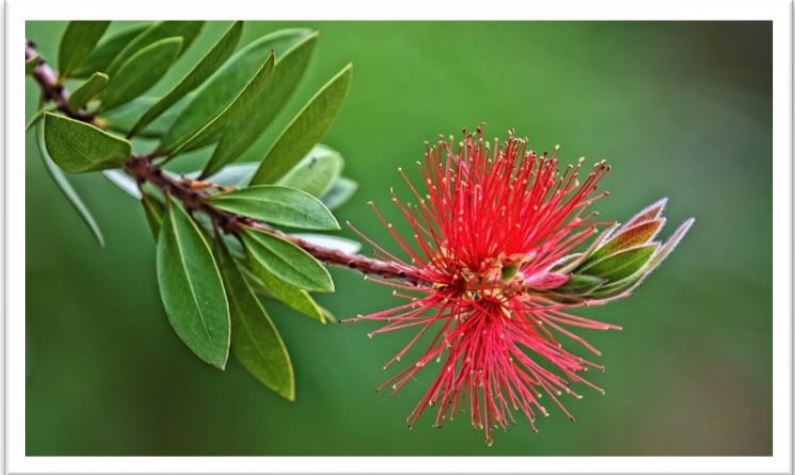
❖ Common name- Bottle brush
❖ Scientific name- Callistemon lanceolatus
❖ Classification-
Kingdom- Plantae
Family- Myrtaceae
Order- Myrtales
❖ Mode of propagation-
Bottlebrushes grow into big shrubs or small trees. They are excellent garden plants and can range from
several feet (1 to 1.5 m.) tall to over 10 feet (3 m.). Most tolerate frost and require little care once
established. Propagating bottle brush is easy with callistemon bottle brush seeds. First, you have to look
for and collect the bottlebrush fruit. Bottlebrush pollen forms on the tips of the long, flower spike
filaments. Each blossom produces a fruit, small and woody, that holds hundreds of tiny callistemon
bottle brush seeds. They grow in clusters along the flower stem and can remain there for years before
the seeds are released.
❖ Uses-
The Bottle brush is a popular ornamental tree.They are woody aromatic trees and the different parts of
this herb have been used in common remedies for treatment of diarrhoea, dysentery and rheumatism. It
is also used as a water accent, anticough, antibronchtits and insecticide in folk medicine. The
innumerable medicinal properties and therapeutic uses of C. citrinus as well as its phytochemical
investigations prove its importance as a valuable medicinal plant.